
Djehuty and his Mother Receiving Offerings, Tomb of Djehuty
1907–1908; original ca. 1427–1400 B.C.
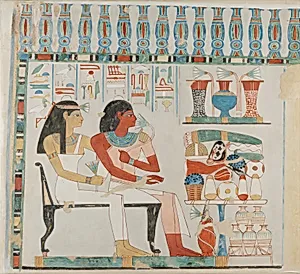
Medium
Tempera on paper
Dimensions
Facsimile: H. 46.2 × W. 51 cm (18 3/16 × 20 1/16 in.); Framed: H. 47.7 × W. 52.1 cm (18 3/4 × 20 1/2 in.); Scale 4:7
Classification
Facsimile, Djehuty (TT 45), offering scene
Period
Twentieth Century; original New Kingdom
Department
Egyptian Art
Museum
Metropolitan Museum of Art, New York, NY
Credit
Rogers Fund, 1915
Accession Number
15.5.8
Rights
Public Domain
Tags
Art Historical Context
This facsimile captures a poignant scene from the Tomb of Djehuty, an official who lived during Egypt’s New Kingdom, Dynasty 18 (ca. 1427–1400 B.C.). Painted in tempera on paper by Norman de Garis Davies between 1907 and 1908, it shows Djehuty seated beside his mother as they receive offerings—an enduring motif meant to sustain the deceased in the afterlife. The original wall painting, now preserved through this careful copy, reflects the period’s refined artistic conventions, with elegant figures, hieroglyphic inscriptions, and a harmonious balance of color and line. Davies, a pioneering Egyptologist and artist, specialized in such facsimiles for the Metropolitan Museum of Art, using traditional tempera techniques to replicate the ancient pigments and brushwork with remarkable fidelity. Measuring just 46 by 51 centimeters, the work allows modern viewers to appreciate details that might otherwise fade on the tomb walls, including the subtle gestures of offering bearers and the precise hieroglyphs that name the figures and record their prayers. Beyond its documentary value, the piece highlights the central role of family and ritual in ancient Egyptian beliefs. By bringing this Dynasty 18 scene into the museum, Davies ensured that the intimate bond between mother and son, and the cultural importance of eternal nourishment, continue to resonate with visitors today.
About the Artist
Norman de Garis Davies · 1865–1941
Norman de Garis Davies (1865–1941) was a British Egyptologist and archaeological artist whose meticulous copies of ancient Egyptian tomb paintings constitute one of the most important records of pharaonic art ever made. Born in Ashton-under-Lyne, Lancashire, he originally trained for the ministry before being drawn into Egyptology through his involvement with the Egypt Exploration Fund in the 1890...