
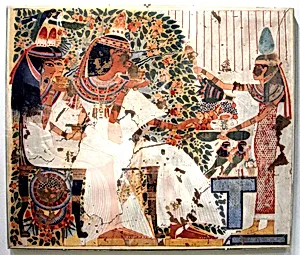
Userhat and Wife Receiving Offerings, Tomb of Userhat
original ca. 1294–1279 B.C.
Medium
Tempera on paper
Dimensions
Facsimile H. 138 (54 5/16 in); w. 162.5 (64 in) Scale 1:1 Framed H. 141 cm (55 1/2 in); w. 165.7 cm (65 1/4 in); 5.1 cm (2 in)
Classification
Facsimile, Userhat (TT 51), offering
Period
Twentieth Century; original New Kingdom, Ramesside
Department
Egyptian Art
Museum
Metropolitan Museum of Art, New York, NY
Credit
Rogers Fund, 1930
Accession Number
30.4.33
Rights
Public Domain
Tags
Art Historical Context
This striking facsimile captures a vivid scene from the tomb of Userhat, a high-ranking official who lived during Egypt’s New Kingdom, Dynasty 19 (ca. 1294–1279 B.C.). Created by British Egyptologist and artist Norman de Garis Davies in the early twentieth century, the tempera-on-paper copy preserves the original wall painting’s lively details at full scale. In the composition, Userhat and his wife are shown seated before tables laden with offerings of food, drink, and flowers, a classic motif intended to sustain them eternally in the afterlife. Davies’s meticulous work belongs to the Metropolitan Museum’s renowned collection of Egyptian facsimiles, produced when many tomb paintings were still in excellent condition but already threatened by environmental damage and tourism. By reproducing the ancient pigments and brushwork so faithfully, these copies allow modern viewers to appreciate the refined style of Ramesside art—its elegant figures, vibrant colors, and harmonious balance—without traveling to the original Theban necropolis. Beyond its aesthetic appeal, the scene reflects core Egyptian beliefs about reciprocity between the living and the dead: offerings depicted on tomb walls were thought to magically nourish the ka, or spirit, of the deceased. This facsimile thus serves as both an artistic treasure and a vital bridge to ancient funerary practices.
About the Artist
Norman de Garis Davies · 1865–1941
Norman de Garis Davies (1865–1941) was a British Egyptologist and archaeological artist whose meticulous copies of ancient Egyptian tomb paintings constitute one of the most important records of pharaonic art ever made. Born in Ashton-under-Lyne, Lancashire, he originally trained for the ministry before being drawn into Egyptology through his involvement with the Egypt Exploration Fund in the 1890...