
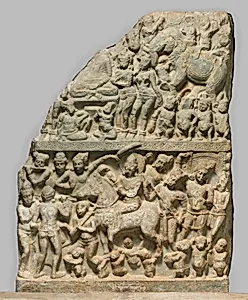
Drum panel with scenes of the Great Departure and Temptation of the Buddha
Unknown Artist
first half of the 3rd century
Medium
Limestone
Dimensions
H. 56 3/4 in. (144.2 cm); W. 36 1/4 in. (92.1 cm); D. 6 in. (15.2 cm); Wt. 854 lbs. (387.5 kg)
Classification
Sculpture
Culture & Period
India (Andhra Pradesh, Nagarjunakonda) · Ikshvaku period
Department
Asian Art
Museum
Metropolitan Museum of Art, New York, NY
Credit
Fletcher Fund, 1928
Accession Number
28.105
Rights
Public Domain
Tags
About this artwork
This monumental limestone drum panel from Nagarjunakonda in Andhra Pradesh represents a masterpiece of early Indian Buddhist sculpture from the Ikshvaku period (first half of the 3rd century CE). Nagarjunakonda flourished as a center of Buddhism under the patronage of Ikshvaku royal women who were active donors to the faith. The panel depicts two of the most significant episodes from the Buddha's life in multiple registers: the Great Departure, showing Prince Siddhartha's renunciation of worldly...
Art Historical Context
Step into the world of early Indian Buddhist art with this monumental limestone drum panel from Nagarjunakonda, Andhra Pradesh, crafted in the first half of the 3rd century during the Ikshvaku period. Carved in deep relief, it vividly captures two pivotal moments from the Buddha's life: the Great Departure, where Prince Siddhartha leaves his palace on horseback to seek enlightenment, and the Temptation, depicting his triumph over Mara, the lord of desire, amid elephants and other symbols of illusion. Measuring over 4.5 feet tall and weighing nearly 850 pounds, this sculpture once adorned a stupa, inviting pilgrims to circle it in devotion. Nagarjunakonda thrived as a Buddhist hub under the generous patronage of Ikshvaku royal women, who funded such grand works to spread the Dharma. These drum panels are masterpieces of narrative storytelling, dividing scenes into multiple registers that unfold like a sacred comic strip, guiding viewers through the Buddha's transformative path despite the constraints of relief carving. What makes this piece extraordinary is its dynamic sculptural technique—figures burst with movement and depth, horses rear dramatically, and compositions draw the eye irresistibly. As a tool for teaching illiterate devotees, it exemplifies how Early Andhra sculpture blended artistry with faith, making profound spiritual journeys accessible and alive.