
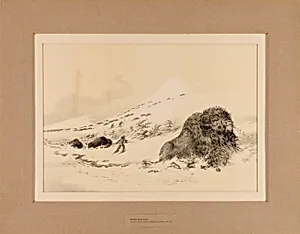
Dying Buffalo--no. 17
Medium
Graphic Arts-Print
Classification
Graphic Arts-Print
Department
Smithsonian Collection
Museum
Smithsonian American Art Museum
Credit
Smithsonian American Art Museum, Transfer from the National Museum of Natural History, Department of Ethnology, Smithsonian Institution
Accession Number
1985.66.386,590O
Rights
Public Domain
Tags
Art Historical Context
George Catlin's *Dying Buffalo--no. 17*, a striking graphic arts print from the Smithsonian American Art Museum, captures a dramatic moment from the vanishing world of the American Plains. Catlin, a 19th-century artist and ethnographer, traveled extensively among Native American tribes in the 1830s, documenting their lives through sketches and paintings before rapid westward expansion altered their traditions forever. This print, part of his renowned series on buffalo hunts, depicts a full-length view of a hunter—likely a Plains Indian—thrusting a spear into a massive buffalo amid a snowy landscape, evoking the raw intensity of survival on the frontier. As a print medium, the work reflects Catlin's commitment to making his observations widely accessible, transforming on-site sketches into reproducible images that educated Eastern audiences about Indigenous cultures. Buffalo were not just game but the lifeblood of Plains tribes, providing food, shelter, and tools; scenes like this highlight their masterful hunting techniques and deep bond with the land. Though the exact date is unknown, it embodies Romanticism's fascination with untamed nature and noble "savages," preserving a cultural narrative now held in the Smithsonian's collection from the National Museum of Natural History. This poignant image invites visitors to reflect on the ecological and human stories intertwined in America's heartland, reminding us of cultures and species teetering on the edge of history.
About the Artist
George Catlin · 1796–1872
George Catlin (1796–1872), born in Wilkes-Barre, Pennsylvania, to Putnam Catlin and Polly Sutton—who had been captured by Native Americans during the 1778 Battle of Wyoming—initially pursued a legal career. Trained at Litchfield Law School, he was admitted to the bar in 1819 but abandoned law after two years to study art in Philadelphia in 1823. Self-taught as a portraitist, Catlin quickly gained ...