
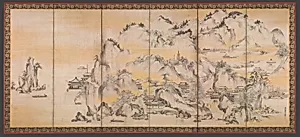
狩野山楽筆 金山西湖図屏風|Jinshan Island and West Lake
1630
Medium
Pair of six-panel folding screens; ink, color, and gold on paper
Dimensions
Image: 60 1/16 in. × 11 ft. 9 in. (152.5 × 358.2 cm) Overall with mounting: 67 5/16 in. × 12 ft. 4 1/4 in. (170.9 × 376.6 cm)
Classification
Paintings
Culture & Period
Japan · Edo period (1615–1868)
Department
Asian Art
Museum
Metropolitan Museum of Art, New York, NY
Credit
Mary Griggs Burke Collection, Gift of the Mary and Jackson Burke Foundation, 2015
Accession Number
2015.300.74.1, .2
Rights
Public Domain
Tags
Art Historical Context
Step into the serene world of Edo-period Japan with *Jinshan Island and West Lake*, a magnificent pair of six-panel folding painted by Kano Sanraku 1630. This work, measuring over 11 feet wide when open, captures the misty grandeur of iconic Chinese landscapes—West Lake's tranquil waters in Hangzhou and the dramatic Jinshan Island rising from the Yangtze River. Crafted in ink, color, and on paper, the screens shimmer with lavish gold leaf backgrounds that evoke infinite space, a hallmark of Japanese decorative arts meant to adorn elite interiors. Kano Sanraku, a master of the Kano school—the dominant painting lineage of the time—infused his landscapes with bold, rhythmic brushwork and vibrant hues. During the peaceful Edo period (1615–1868), such screens were status symbols for samurai and merchants, blending Chinese subject matter with Japanese aesthetic refinement. Sanraku's dynamic compositions, with towering mountains and flowing rivers, reflect the school's emphasis on harmony between nature and stylized elegance, drawing viewers into an idealized vision of the natural world. Now housed in the Metropolitan Museum of Art as part of the Mary Griggs Burke Collection, this pair exemplifies the technical virtuosity of rimpa-influenced Kano art, where gold not only beautifies but symbolizes purity and eternity. A true treasure for any visitor!
About the Artist
Kano Sanraku (Japanese) · 1559 –1635
Japanese, 1559–1635