
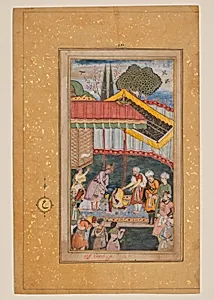
"Emperor Babur Receiving a Visitor", Folio from a Baburnama (The Book of Babur)
Unknown Artist
ca. 1590
Medium
Ink, opaque watercolor, and gold on paper
Dimensions
Page: H. 14 in. (35.6 cm) W. 9 in. (22.8 cm) Painting (with margins): H. 10 1/4 in. (26 cm) W 5 13/16 in. (14.7 cm) Painting: H. 9 1/4 in. (23.5 cm) W. x 4 15/16 in. (12.6 cm)
Classification
Codices
Department
Islamic Art
Museum
Metropolitan Museum of Art, New York, NY
Credit
Louis V. Bell Fund, 1967
Accession Number
67.266.4
Rights
Public Domain
Tags
Art Historical Context
"Emperor Babur Receiving a Visitor" is a captivating folio from the *Baburnama*, the memoir of Zahir al-Din Muhammad Babur (1483–1530), the Timurid prince who founded the Mughal Empire in India in 1526. Written in Chagatai Turkish, Babur's autobiography offers intimate insights into his life, conquests, and observations on nature, poetry, and governance. This illustration, created around 1590 during the reign of Babur's grandson Akbar, depicts the emperor graciously welcoming a guest, embodying the Mughal ideal of refined courtly etiquette and hospitality. Such folios were part of luxurious illustrated manuscripts produced in imperial ateliers to celebrate and preserve dynastic history. Rendered in ink, opaque watercolor, and gold on paper, the artwork exemplifies the exquisite precision of Mughal miniature painting. Fine ink outlines define figures and architecture, while vibrant opaque pigments create rich, jewel-like colors, and gold accents add a luminous, regal glow. The compact painting measures about 9¼ by 4⅞ inches, typical for codex pages designed for intimate viewing. This technique, rooted in Persian traditions but distinctly Mughal in its naturalism and detail, highlights the cultural synthesis of Central Asian, Persian, and Indian influences. Housed in the Metropolitan Museum of Art's Islamic Art Department, this folio underscores the *Baburnama*'s role in Mughal self-fashioning—transforming a personal memoir into a visual epic of empire-building. Visitors will appreciate how it brings Babur's world vividly to life, revealing the humanity behind a conqueror.