
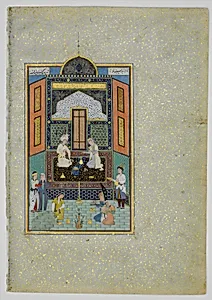
"Bahram Gur in the White Palace on Friday", Folio 235 from a Khamsa (Quintet) of Nizami of Ganja
A.H. 931/1524–25 CE
Medium
Opaque watercolor, ink, and gold on paper
Dimensions
Painting: H. 8 13/16 in. (22.4 cm) W. 4 1/2 in. (11.4 cm) Page: H. 12 5/8 in. (32.1 cm) W. 8 3/4 in. (22.2 cm) Mat: H. 19 1/4 in. (48.9 cm) W. 14 1/4 in. (36.2 cm)
Classification
Codices
Department
Islamic Art
Museum
Metropolitan Museum of Art, New York, NY
Credit
Gift of Alexander Smith Cochran, 1913
Accession Number
13.228.7.14
Rights
Public Domain
Tags
Art Historical Context
This exquisite folio comes from a lavishly illustrated Khamsa (Quintet) of Nizami, one of the most celebrated works of classical Persian poetry. Created in 1524–25 during the early Safavid period, the manuscript recounts the romantic adventures of the Sasanian king Bahram Gur. In this scene, the ruler visits the White Palace on Friday, where he encounters a princess associated with the planet Venus. The illustration captures an intimate interior moment, rich with architectural detail and courtly figures, reflecting the poem’s blend of narrative drama and symbolic meaning. Executed in opaque watercolor, ink, and gold on paper by artists Sultan Muhammad Nur and Shaikh Zada, the painting exemplifies the refined techniques of Persian miniature art. Delicate brushwork, vibrant pigments, and intricate gold illumination highlight the luxurious setting and the elegant interplay between figures. Such codices were prized possessions of royal and noble patrons, serving both as literary treasures and displays of cultural sophistication. Housed today in the Metropolitan Museum of Art’s Islamic Art department, this folio offers visitors a vivid window into 16th-century Persian aesthetics and storytelling traditions. Its harmonious composition and luminous details continue to enchant, revealing how art and literature intertwined to celebrate beauty, love, and kingship.