
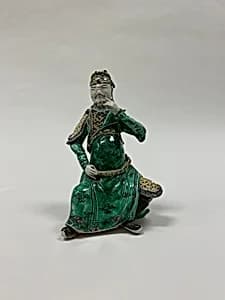
Figure of Guan Yu, a guardian deity
Unknown Artist
19th century
Medium
Biscuit with polychrome enamels (Jingdezhen ware)
Dimensions
H. 7 7/8 in. (20 cm); W. 5 in. (12.7 cm); D. 3 1/2 in. (8.9 cm)
Classification
Ceramics
Culture & Period
China · Qing dynasty (1644–1911)
Department
Asian Art
Museum
Metropolitan Museum of Art, New York, NY
Credit
Gift of Edwin C. Vogel, 1963
Accession Number
63.213.11
Rights
Public Domain
Tags
Art Historical Context
This 19th-century ceramic figure from China portrays Guan Yu as a guardian deity, a figure long associated with loyalty, protection, moral strength in Chinese tradition. Created during the Qing dynasty, such sculptures were popular in homes and temples, serving both as decorative objects and expressions of devotion. The small, intimate scale of this piece—standing just under 8 inches tall—suggests it was intended for personal or household use, bringing spiritual presence into everyday life. Produced as Jingdezhen ware, the figure is made of biscuit porcelain (unglazed ceramic) decorated with polychrome enamels. Jingdezhen, China’s historic center of porcelain production, excelled at this technique, which allowed artisans to apply vibrant colors and fine details directly onto the fired body for a lively, expressive effect. The unknown maker’s skill is evident in the careful modeling and colorful surface, typical of late Qing ceramic figures. Gifted to the Metropolitan Museum of Art in 1963, this work offers visitors a glimpse into Qing-dynasty craftsmanship and the cultural role of ceramics in depicting revered deities. It highlights how art, religion, and daily life intertwined in 19th-century China.