
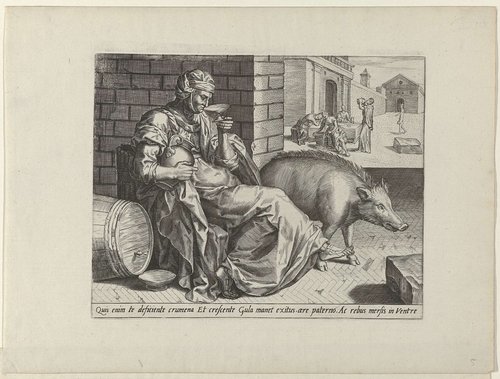
Gulzigheid
1550 - 1625
Medium
engraving
Dimensions
256; 205
Rights
Public Domain
About this artwork
collector's mark: Lugt 2228
Art Historical Context
**Gulzigheid** *Pieter Jalhea Furnius, ca. 1550–1625* *Engraving, 205 × 256 mm* Step into the intricate world of 16th- to 17th-century Northern European printmaking with *Gulzigheid* ("Gluttony" in Dutch), an engraving by the lesser-known yet skilled artist Pieter Jalhea Furnius. Active during the late Renaissance, Furnius contributed to a vibrant tradition of Flemish and Dutch graphic arts, where engravings served as affordable vehicles for moral and allegorical themes. This modestly scaled print (about 8 x 10 inches) exemplifies how such works democratized art, allowing images to circulate widely among collectors and the middle class. Engraving's meticulous technique—incising fine lines into a copper plate, inking it, and pressing paper to capture tonal depth—was revolutionary for its precision and reproducibility. Furnius's piece likely embodies the era's fascination with the Seven Deadly Sins, using vivid imagery to warn against excess in a time of religious upheaval and sumptuary laws. The presence of Lugt 2228, a collector's mark from a distinguished 19th-century provenance, underscores its enduring appeal to connoisseurs, highlighting engravings' role in preserving cultural narratives across centuries. Discover how this small yet potent work reflects humanity's timeless struggle with vice, inviting reflection in our virtual gallery.
About the Artist
Pieter Jalhea Furnius · 1530–1615
Pieter Jalhea Furnius (1530–1615, though some sources suggest 1545–1610) was a Flemish engraver and draughtsman who worked during the height of Antwerp Mannerism, creating engravings that disseminated the works of prominent Northern European artists throughout Europe. Trained under the renowned painter Lambert Lombard in Liège, Furnius established himself in Antwerp, the commercial and artistic ca...