
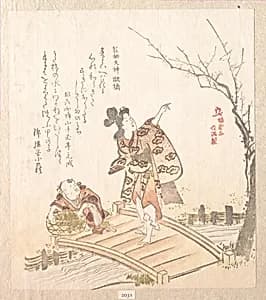
History of Kamakura: Poem-bridge of Egara Tenjin Shrine
19th century
Medium
Woodblock print (surimono); ink and color on paper
Dimensions
8 1/4 x 7 3/16 in. (21 x 18.3 cm)
Classification
Prints
Culture & Period
Japan · Edo period (1615–1868)
Department
Asian Art
Museum
Metropolitan Museum of Art, New York, NY
Credit
H. O. Havemeyer Collection, Bequest of Mrs. H. O. Havemeyer, 1929
Accession Number
JP2031
Rights
Public Domain
Tags
Art Historical Context
Step into the vibrant world of Edo-period Japan with *History of Kamakura: Poem of Egara Tenjin*, a delicate woodblock print (surono) by Kuboman, created in the 19th century. This intimate 8¼ x 7⅛-inch artwork, rendered in ink and color on paper, to Shunman's celebrated series documenting the historic city's landmarks. Surimono like this were luxurious, privately commissioned prints—often for New Year's greetings or poetry gatherings—featuring superior craftsmanship with embossed details, metallic pigments, and refined compositions that set them apart from mass-produced ukiyo-e. The scene captures the iconic Poem-bridge at Egara Tenjin Shrine in Kamakura, a site honoring the deified scholar Sugawara no Michizane. Shunman masterfully depicts men and women crossing the arched bridge amid lush trees, evoking the era's fascination with famous places (meisho-e). Bridges symbolized transitions in Japanese culture, blending human activity with nature's serenity, while the shrine's poetic legacy ties into Shunman's own renown as a kyōka poet and illustrator. Housed in the Metropolitan Museum of Art's H. O. Havemeyer Collection, this print exemplifies Shunman's elegant style—crisp lines, harmonious colors, and subtle spatial depth—offering a window into 19th-century Japan's refined urban pleasures and reverence for history.
About the Artist
Kubo Shunman · 1757–1820
Japanese, 1757–1820