
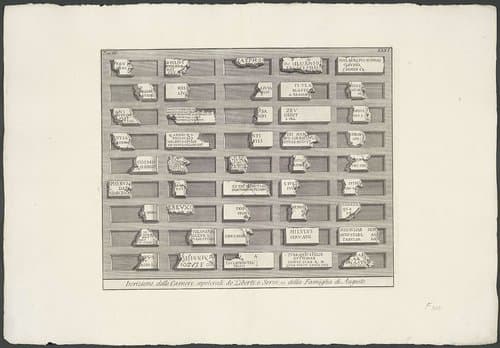
Inscripties uit de graftombe van de vrijgelatenen en slaafgemaakten van de familie van Augustus
ca. 1756 - ca. 1757
Medium
etching
Dimensions
477; 398
Rights
Public Domain
About this artwork
verzamelaarsmerk, verso, gestempeld: Lugt 2228
Art Historical Context
Giovanni Battista Piranesi, the visionary 18th-century Italian and architect, created this etching around 1756–1757 as part of his meticulous documentation of ancient Roman antiquities. Titled *Inscripties uit deombe van de vrijgelen en slaafgemaakten van de familie van Augustus* (Inscriptions from the Tomb of the Freedmen and Freed Slaves of the Family of Augustus), it captures detailed epigraphy from a significant imperial mausoleum. Measuring 398 × 477 mm, the work exemplifies Piranesi's etching technique, where acid bites into copper plates to produce intricate lines, ideal for rendering the precise, weathered letters of ancient stone inscriptions. This artwork holds profound historical value, preserving inscriptions from the tomb of Augustus's household—freed slaves and former captives who rose in Roman society. Piranesi's series on Roman ruins and texts fueled the 18th-century fascination with classical antiquity, influencing Neoclassicism and archaeology. His dramatic style blends scholarly accuracy with artistic flair, making the past vividly tangible. A collector's mark (Lugt 2228) on the verso hints at its esteemed provenance among connoisseurs. For visitors, this etching bridges eras, inviting reflection on social mobility in ancient Rome through Piranesi's masterful lens.
About the Artist
Giovanni Battista Piranesi · 1720–1778
Giovanni Battista Piranesi (1720–1778) was an Italian printmaker, architect, and antiquarian whose visionary etchings of Rome and imaginary prisons revolutionized architectural representation and profoundly influenced both Neoclassicism and Romanticism. Piranesi stands as one of the most important printmakers of the eighteenth century, fundamentally shaping European perceptions of ancient Rome an...