
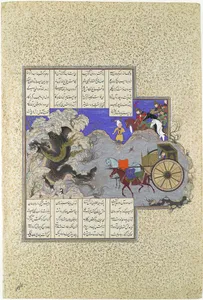
"Isfandiyar's Third Course: He Slays a Dragon", Folio 434v from the Shahnama (Book of Kings) of Shah Tahmasp
Medium
Opaque watercolor, ink, silver, and gold on paper
Dimensions
Painting: H. 11 in. (27.9 cm) W. 10 5/16 in. (26.2 cm) Page: H. 18 5/8 in. (47.3 cm) W. 12 1/2 in. (31.8 cm) Mat: H. 22 in. (55.9 cm) W. 16 in. (40.6 cm)
Classification
Codices
Department
Islamic Art
Museum
Metropolitan Museum of Art, New York, NY
Credit
Gift of Arthur A. Houghton Jr., 1970
Accession Number
1970.301.51
Rights
Public Domain
Tags
Art Historical Context
This magnificent folio comes from the Shahnameh (Book of Kings) of Shah Tahmasp one of the most lavish illustrated manuscripts ever created in Persia. Produced around 1530 during the Safavid dynasty, the volume brought together the epic poetry of Abu’l Qasim Firda with the talents of the royal workshop’s finest painters. The scene captures the legendary hero Isfandiyar in his third trial, confronting and slaying a fearsome dragon—an episode that highlights themes of courage and destiny central to Persian storytelling. Painted by the artist Qasim ibn ‘Ali in opaque watercolor, ink, gold, and silver on paper, the illustration exemplifies the refined techniques of Persian miniature painting. Delicate brushwork, vibrant mineral pigments, and shimmering metallic details create a dynamic composition that draws the viewer into the dramatic moment. The generous use of gold and silver not only enhances the visual splendor but also signals the manuscript’s royal patronage and extraordinary craftsmanship. Housed today in the Metropolitan Museum of Art’s Department of Islamic Art, this folio offers modern visitors a vivid window into 16th-century Persian culture, where literature, art, and courtly patronage intertwined to celebrate national heritage and heroic ideals.
About the Artist
Qasim ibn 'Ali|Abu'l Qasim Firdausi (Iranian|Iranian) · 1500 |0935 –1585 |1020
Iranian, active ca. 1525–60|Iranian, Paj ca. 940/41–1020 Tus