
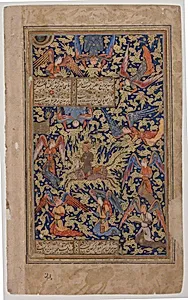
"Muhammad Ascends to Heaven in a Vision on Buraq", Folio from a Yusuf and Zulaikha of Jami
second half 16th century
Medium
Opaque watercolor and gold on paper
Dimensions
H. 9 in. (22.9 cm) W. 5 1/4 in. (13.3 cm)
Classification
Codices
Department
Islamic Art
Museum
Metropolitan Museum of Art, New York, NY
Credit
Cora Timken Burnett Collection of Persian Miniatures and Other Persian Art Objects, Bequest of Cora Timken Burnett, 1956
Accession Number
57.51.39.152
Rights
Public Domain
Tags
Art Historical Context
This exquisite folio, titled *"Muhammad Ascends to in a Vision on Bq"*, comes from a 16th-century manuscript ofYusuf and Zulaikha*, the renowned Persian poem by Maulana Nur al-Din `Abd al-Rahman Jami. It vividly captures the Islamic prophet Muhammad's miraculous Mi'raj—the night journey from Mecca to Jerusalem and ascent to heaven astride the mythical steed Buraq. Rendered in the Safavid Persian miniature tradition, the scene blends human figures with fantastical elements, evoking spiritual transcendence amid swirling clouds and ethereal architecture. Crafted in the second half of the 16th century with opaque watercolor and gold on paper, the artwork measures a intimate 9 x 5¼ inches, perfect for the pages of a codex. Gold accents illuminate divine rays and Buraq's wings, a hallmark technique of Persian illumination that creates luminous depth and otherworldly glow. These miniatures, produced in royal workshops, exemplify the era's mastery of fine-line detail and vibrant palettes, turning poetry into visual splendor. Housed in the Metropolitan Museum of Art's Cora Timken Burnett Collection, this piece highlights Persian Islam's rich fusion of literature, mysticism, and art. It invites visitors to ponder the Mi'raj's enduring cultural resonance—a pivotal event symbolizing faith's ascent—while marveling at the delicate beauty of Safavid codices.
About the Artist
Maulana Nur al-Din `Abd al-Rahman Jami · 1414–1492
**Maulana Nur al-Din `Abd al-Rahman Jami** (1414–1492) stands as one of the towering figures of Persian literature and Sufi thought during the Timurid era. Born in Kharjerd near Jam in Khorasan (present-day Iran) to a Persian family, he later adopted “Jami” as his pen name. His father, Nizam al-Din Ahmad, a theologian, lawyer, and Sufi, served as his first teacher and mentor. The family soon moved...