
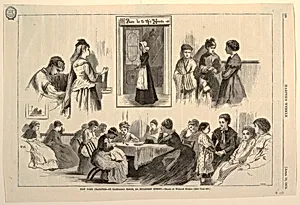
New York Charities - St. Barnabas House, 304 Mulberry Street
April 18, 1874
Classification
graphic design
Department
Smithsonian Collection
Museum
Smithsonian American Art Museum
Credit
Gift of Cora Wilson
Accession Number
1939-70-7
Rights
Public Domain
About this artwork
Research in Progress
Art Historical Context
**New York Charities - St. Barnabas House, 304 Mulberry Street** *Winslow Homer, American, 1836–1910, April 18, 1874* Winslow Homer, one of America's foremost realist artists, captured the raw energy of everyday life in works that bridged illustration and fine art. Best known for his powerful depictions of the Civil War, rural scenes, and turbulent seascapes, Homer began his career as a commercial illustrator for *Harper's Weekly*. This 1874 graphic design piece reflects that early expertise, turning his keen observational eye toward urban social issues in post-Civil War New York. Created amid the city's booming yet stratified Gilded Age landscape, the artwork spotlights St. Barnabas House at 304 Mulberry Street—a charitable institution amid the gritty tenements of lower Manhattan. Mulberry Street, heart of immigrant neighborhoods like the Five Points slums, symbolized both hardship and humanitarian efforts. Homer's realistic style likely highlighted the human stories behind philanthropy, using precise lines and dramatic contrasts typical of 19th-century graphic media to evoke empathy and awareness. Though research continues on its exact techniques, this Smithsonian treasure (gift of Cora Wilson) underscores Homer's versatility and commitment to documenting American society. It invites visitors to ponder how art illuminated the era's charitable impulses, blending artistry with social commentary in a single, compelling frame.