
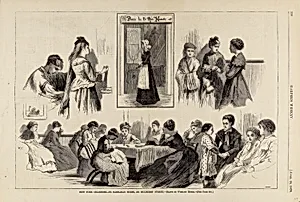
New York Charities--St. Barnabas House, from Harper's Weekly, April 18, 1874
1874
Medium
Graphic Arts-Print
Classification
Graphic Arts-Print
Department
Smithsonian Collection
Museum
Smithsonian American Art Museum
Credit
Smithsonian American Art Museum, The Ray Austrian Collection, gift of Beatrice L. Austrian, Caryl A. Austrian and James A. Austrian
Accession Number
1996.63.95
Rights
Public Domain
Tags
Art Historical Context
Winslow Homer's *New York Charities--St. Barnabas House*, published in *Harper's Weekly* on April 18, 1874, offers a poignant glimpse into Gilded Age philanthropy in New York City. As a leading illustrator for the influential weekly magazine, Homer captured the bustling urban scene of charitable institutions like St. Barnabas House, a home likely aiding women and children amid rapid industrialization and immigration. This wood engraving print reflects the era's growing awareness of social welfare, blending realism with journalistic urgency to humanize the city's underprivileged. Homer, a pioneer of American realism, excelled in graphic arts, translating his keen observations into intricate wood engravings that rivaled paintings in detail and emotion. Here, his technique—precise lines and tonal contrasts—conveys the dignity of charity work, with female figures central to the composition, underscoring women's pivotal roles in 19th-century benevolence. Published during a time when *Harper's Weekly* shaped public opinion, the image educated middle-class readers on urban poverty. Housed in the Smithsonian American Art Museum's Ray Austrian Collection, this print exemplifies Homer's evolution from Civil War correspondent to chronicler of American life, inviting us to reflect on enduring themes of compassion and community.
About the Artist
Winslow Homer · 1836–1910
Winslow Homer (1836-1910) was one of America's greatest painters and a preeminent figure in 19th-century American art. Largely self-taught, Homer began his career as a commercial illustrator and Civil War correspondent for Harper's Weekly before becoming renowned for his powerful marine subjects and landscape paintings. His mastery of both oil and watercolor, combined with his uncompromising reali...