
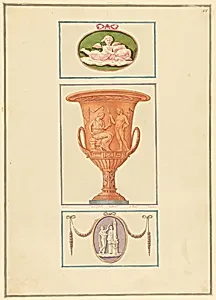
Ornament Design with Krater and Cameos
Classification
Drawing
Department
Smithsonian Collection
Museum
Smithsonian American Art Museum
Credit
Gift of Unknown Donor
Accession Number
1980-32-1468
Rights
Public Domain
About this artwork
Research in Progress
Art Historical Context
**Ornament Design with Kr and Cameos** (1777) is a delicate drawing by Michel Angelo Pergolesi, an artist active from around 1760 to 1801, now housed in the Smithsonian American Art Museum collection. Pergolesi, who worked extensively in England, specialized in ornamental designs inspired by antiquity, often publishing pattern books for architects, furniture makers, and decorators. This exemplifies his talent for blending classical motifs into elegant, functional art, featuring a krater—an ancient Greek vessel used for mixing wine—and intricately carved cameos, which evoke the portrait gems popular among Renaissance and Enlightenment collectors. Created during the Neoclassical era, the drawing reflects the 18th-century fascination with Greco-Roman artifacts unearthed through excavations like those at Herculaneum and Pompeii. Neoclassicism sought to revive ancient ideals of harmony and proportion, influencing everything from architecture to household wares. Pergolesi's design likely served as a template for decorative objects, such as ceramics, wallpaper, or silverwork, bridging archaeological discovery with everyday luxury. Though the exact medium remains undocumented and research continues, this work highlights the era's ornamental revival, where artists like Pergolesi democratized classical elegance. A gift from an unknown donor, it invites us to appreciate how such designs shaped the refined interiors of Georgian England, connecting visitors to the enduring allure of antiquity.