
明 胡正言 《十竹齋書畫譜》 四開 木版畫|Page from the Ten Bamboo Studio Manual of Painting and Calligraphy
first edition printed in 1633
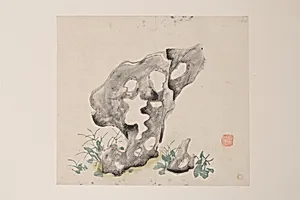
Medium
Individual leaf from a printed book; ink and color on paper
Dimensions
9 7/16 x 10 3/4 in. (24 x 27.3 cm)
Classification
Prints
Culture & Period
China · Ming dynasty (1368–1644)
Department
Asian Art
Museum
Metropolitan Museum of Art, New York, NY
Credit
Rogers Fund, 1924
Accession Number
CP83
Rights
Public Domain
Art Historical Context
Step into the refined world of late Ming dynasty artistry with this exquisite page from Hu Zhengyan's *Ten Studio Manual of Painting andigraphy* (1633). Produced at the artist's own studio in Nanjing, this first-edition woodblock print captures the elegance of Chinese literati culture during the Ming period (1368–1644). Hu Zhengyan, master publisher, calligrapher, and painter, created this groundbreaking manual as both a technical showcase and instructional guide, blending calligraphy, painting motifs, and decorative designs on a modest 9 7/16 x 10 3/4 in. leaf of ink-and-color-on-paper. What sets this work apart is its pioneering polychrome woodblock printing technique, using multiple carved blocks to layer vibrant colors with remarkable precision—often up to ten blocks per image—mimicking the fluidity of brushwork. This innovation elevated printmaking from mere reproduction to an art form rivaling paintings, influencing generations of East Asian artists and printers. Housed in the Metropolitan Museum of Art's Asian Art department (Rogers Fund, 1924), this leaf exemplifies Ming China's cultural zenith, where scholarship and aesthetics intertwined. Visitors will appreciate how it democratized elite arts, making "bamboo studio" elegance accessible beyond imperial courts.
About the Artist
Hu Zhengyan · 1584–1634
Hu Zhengyan (胡正言, c. 1584–c. 1674) was a Chinese artist, publisher, seal-carver, and printmaking innovator who lived through the turbulent transition from the Ming to the Qing dynasty. Born in Xiuning in Anhui province, he eventually settled in Nanjing, where he established his home and workshop on a hill within the northern city wall and named the property the Ten Bamboo Studio, or Shizhuzhai, af...