
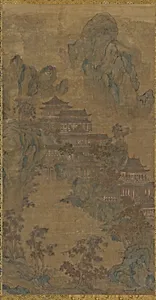
Palace in the Mountains
16th-17th century
Classification
Painting
Department
Smithsonian Collection
Museum
Smithsonian American Art Museum
Credit
Gift of Charles Lang Freer
Accession Number
F1916.55
Rights
Public Domain
Tags
About this artwork
To 1916
Art Historical Context
"Palace in the Mountains is a captivating Chinese landscape painting traditionally attributed to the Song dynasty artist Zhao Bojuca. 1120s–ca. 1162), though dated to the 16th–17th century during the Ming dynasty1368–1644). This work evokes the grandeur of imperial architecture harmoniously integrated into towering, mist-shrouded peaks, a common motif in Chinese art symbolizing harmony between humanity and nature. Rendered in the iconic blue-and style, the painting employs vivid mineral pigments—azurite blues and malachite greens—on what was likely silk or paper, creating an luminous, almost fantastical atmosphere. Popularized in the Tang and Song eras, this technique was revived in the Ming period to convey the sublime power of mountains and the elegance of palaces, inviting viewers to contemplate the vastness of the cosmos. Acquired by collector Charles Lang Freer before 1916 and gifted to the Smithsonian American Art Museum, this piece exemplifies the global appreciation of Chinese art. It bridges centuries, showcasing how Ming artists honored earlier masters like Zhao Boju while infusing their own era's refined aesthetic.