
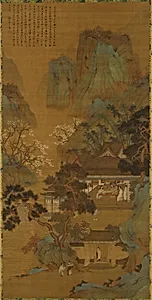
The hall of precious paintings 寶繪堂圖
17th century
Classification
Painting
Department
Smithsonian Collection
Museum
Smithsonian American Art Museum
Credit
Gift of Charles Lang Freer
Accession Number
F1909.157
Rights
Public Domain
Tags
About this artwork
Depicts, in the "blue and green style," an open pavilion overlooking a landscape with a bay. The mountainous landscape is dotted with various flowering trees and vines, as well as pine and bamboo. In the open pavilion three scholars, accompanied by two attendants, examine a painting. They are surrounded by three tables piled with bundles of scrolls and archaic metal vessels, and by a painting on a screen. In the courtyard outside the pavilion, a servant carries a red tray with cups. The pavilion...
Art Historical Context
This captivating 17th-century painting, titled *The Hall of Precious Paintings*, is a later copy after the renowned Ming dynasty master Qiu Ying (ca. 1494–1552). Created in the distinctive “blue-and-green” style, it employs vibrant mineral pigments to the luminous landscapes of earlier Chinese traditions. Qiu Ying himself was celebrated for his meticulous brushwork and elegant depictions of scholars amid nature, and this work continues that refined aesthetic even as a Qing-era interpretation. The scene unfolds in an open pavilion perched above a serene bay, where three scholars intently examine a scroll while surrounded by treasured paintings, archaic bronzes, and stacks of rolled documents. Outside, a servant approaches with refreshments, and two figures arrive bearing more artworks, all framed by flowering trees, pines, and bamboo. The composition celebrates the refined world of connoisseurship and the deep cultural value placed on art collecting during China’s imperial eras. Housed in the Smithsonian’s collections as part of Charles Lang Freer’s generous gift, the painting offers a window into centuries of artistic transmission. Its detailed courtyard, lion-flanked gate, and harmonious landscape remind viewers of the enduring Chinese ideal that art and nature together cultivate wisdom and harmony.