
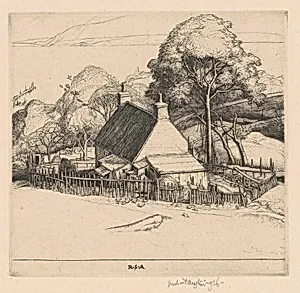
Plane Tree Cottage
1926
Medium
engraving in black on laid paper
Dimensions
plate: 13.97 × 14.61 cm (5 1/2 × 5 3/4 in.) sheet: 20.8 × 26.83 cm (8 3/16 × 10 9/16 in.)
Classification
Department
CG-W
Museum
National Gallery of Art, Washington, D.C.
Credit
Corcoran Collection (Gift of E. Gerald Lamboley)
Accession Number
2015.143.1354
Rights
Public Domain
Art Historical Context
**Plane Tree Cottage** (1926) is a delicate engraving by British artist Robert Austin, capturing the serene charm of rural England. Created during the interwar period, printmaking enjoyed a revival among artists seeking affordable ways to share intricate works, this piece exemplifies Austin's mastery of line engraving. Working on a modest plate measuring just 13.97 × 14.61 cm, Austin incised fine lines into metal, inking them to produce rich blacks on laid paper—a traditional support prized for its subtle texture that enhances the print's depth. As an intaglio technique, engraving allowed Austin to achieve remarkable precision and tonal subtlety, evoking atmosphere through cross-hatching and delicate shading. Austin, a prominent figure in early 20th-century British printmaking, drew from realist traditions while infusing his scenes with quiet poetry; the title hints at a quaint cottage nestled among plane trees, a nod to England's pastoral heritage amid rapid modernization. Housed in the National Gallery of Art's Corcoran Collection (Gift of E. Gerald Lamboley), this print highlights the enduring appeal of small-scale masterpieces that invite close contemplation. Its classification as a print underscores the democratic nature of the medium, making fine art accessible beyond oil paintings. Visitors will appreciate how Austin's meticulous craft turns everyday landscapes into timeless vignettes.
About the Artist
Robert Austin · 1895–1973
Robert Sargent Austin RA PPRWS PPRE (1895–1973) was a preeminent British engraver, draughtsman, illustrator, and painter, born in Leicester, England, where his prodigious talent emerged early—at just eight years old, he exhibited with the Royal Drawing Society.) He trained first at the Leicester Municipal School of Art from 1909 to 1913, then at the Royal College of Art from 1914–1916 and 1919–192...