
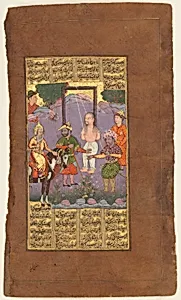
"Rescue of Bizhan by Piran", Folio from a Shahnama (Book of Kings) of Firdausi
ca. 1610
Medium
Ink, opaque watercolor, and gold on paper
Dimensions
Page: H. 7 7/8 in. (20 cm) W. 4 3/4 in. (12.1 cm) Painting: H. 5 3/16 in. (13.2 cm) W. 2 3/4 in. (7 cm)
Classification
Codices
Department
Islamic Art
Museum
Metropolitan Museum of Art, New York, NY
Credit
Gift of Wendy Findlay, 1983
Accession Number
1983.354.1
Rights
Public Domain
Tags
Art Historical Context
Behold the dramatic "Rescue of Bizhan Piran," a folio from a *Shahnama* (Book of Kings) by the legendary Persian poet Abu'l Qasim Firda. Created around 1610 during the Safavid era in Iran, this miniature captures a pivotal moment from the epic: the Turanian warrior Piran heroically rescuing the Persian prince Bizhan from peril amid clashing horses and men. The *Shahnama*, completed by Firdausi around 0 CE, chronicles Iran's mythical kings and heroes, blending history, legend, and moral tales that shaped Persian identity for centuries. Crafted in the exquisite tradition of Persian painting, the artwork employs ink outlines, vibrant opaque watercolors, and shimmering gold on paper, measuring just 7 7/8 by 4 3/4 inches. These intimate codices were prized treasures, often produced in royal workshops, where artists layered rich hues and intricate details to evoke motion and emotion in flattened, bird's-eye compositions. Gold accents highlight the dynamic tangle of rearing horses and armored figures, embodying the Safavid mastery of narrative illustration. Housed in the Metropolitan Museum of Art's Islamic Art Department, this folio—generously gifted in 1983—offers a window into a golden age of manuscript art, where poetry and painting intertwined to preserve cultural heritage. Visitors, imagine turning its pages in a candlelit library, alive with ancient valor!
About the Artist
Abu'l Qasim Firdausi · 935–1020
Abu'l Qasim Firdausi, born around 940 in the village of Paj near Tus in Khorasan (modern-day Iran), emerged from a family of landed gentry known as dehqans, who preserved ancient Iranian oral traditions amid the cultural renaissance of the Samanid Empire. Little is documented about his early life or formal training, though he likely received a basic education including Arabic literacy, immersing h...