
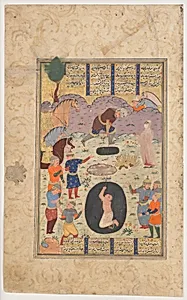
"Rustam rescues Bizhan from the Pit", Folio from a Shahnama (Book of Kings)
1560–80
Medium
Opaque watercolor, silver, and gold on paper
Dimensions
Page: H. 14 5/8 in. (37.1 cm) W. 8 7/8 in. (22.5 cm) Painting: H. 10 3/4 in. (27.3 cm) W. 7 3/4 in. (19.7 cm)
Classification
Codices
Department
Islamic Art
Museum
Metropolitan Museum of Art, New York, NY
Credit
Purchase, Rogers Fund and Joseph V. McMullan Gift, 1965
Accession Number
65.7.2
Rights
Public Domain
Tags
Art Historical Context
This exquisite folio from a Shahnama manuscript captures a dramatic moment from the Persian epic poem composed by Abu'l Qasim Firdausi. It depicts the legendary hero Rustam rescuing his comrade Bizhan from a pit, a tale of bravery and loyalty drawn from ancient Iranian mythology. Created between 1560 and 1580, the work reflects the enduring popularity of the Shahnama during the Safavid era, when such illustrated manuscripts served as both literary treasures and symbols of cultural identity for royal and noble patrons. Executed in opaque watercolor with delicate touches of silver and gold on paper, the painting exemplifies the refined techniques of Persian miniature art. The luminous pigments and intricate details bring vitality to the figures of men, women, and horses, while the vertical format suits the codex format typical of Islamic book arts. These materials not only enhance the visual richness but also highlight the manuscript's status as a luxurious object meant for intimate viewing and storytelling. Housed in the Metropolitan Museum of Art's Department of Islamic Art, this page underscores the Shahnama's role in preserving and celebrating Persian heritage across centuries. Its blend of narrative power and artistic elegance continues to invite viewers into a world of mythic adventure and timeless human themes.
About the Artist
Abu'l Qasim Firdausi · 935–1020
Abu'l Qasim Firdausi, born around 940 in the village of Paj near Tus in Khorasan (modern-day Iran), emerged from a family of landed gentry known as dehqans, who preserved ancient Iranian oral traditions amid the cultural renaissance of the Samanid Empire. Little is documented about his early life or formal training, though he likely received a basic education including Arabic literacy, immersing h...