
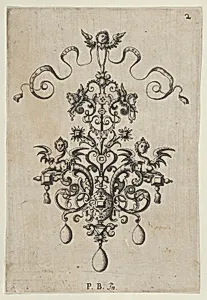
Reverse Copy of Design for a Pendant, from Ars His Myronis Nobilis Effingitus Pagellulis
ca. 1600
Medium
Engraving
Dimensions
Sheet: 5 1/4 × 3 5/8 in. (13.4 × 9.2 cm)
Classification
Prints|Ornament & Architecture
Department
Drawings and Prints
Museum
Metropolitan Museum of Art, New York, NY
Credit
Harris Brisbane Dick Fund, 1923
Accession Number
23.88.2
Rights
Public Domain
Tags
Art Historical Context
This delicate engraving by Paul Birckenhultz, created around 1600, offers a rare glimpse into the world of Renaissance jewelry design. Titled *Reverse Copy of Design for a Pendant*, the work belongs to the publication *Ars His Myronis Nobilis Effingitus Pagellulis*, a collection of ornamental prints intended for craftsmen. At just 5 1/4 by 3 5/8 inches, the small sheet demonstrates how engravers captured intricate details—such as scrolling motifs, gem settings, and suspended elements—to guide goldsmiths in creating wearable art for the nobility. As part of the Metropolitan Museum’s Department of Drawings and Prints, this piece highlights the vital role of printmaking in spreading decorative ideas across Europe. Classified under Ornament & Architecture, it served not only as a practical template but also as a record of evolving tastes in jewelry during the late Renaissance. The “reverse copy” nature suggests it was produced to facilitate transfer techniques, allowing artisans to trace the design directly onto metal. Such engravings bridged fine art and craftsmanship, preserving ephemeral designs that might otherwise have been lost. Today, visitors can appreciate how Birckenhultz’s precise lines transformed fleeting sketches into enduring sources of inspiration for both historical and contemporary jewelry makers.