
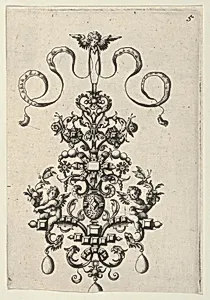
Reverse Copy of Design for a Pendant, from Ars His Myronis Nobilis Effingitus Pagellulis
ca. 1600
Medium
Engraving
Dimensions
Sheet: 4 15/16 × 3 7/16 in. (12.6 × 8.7 cm)
Classification
Prints|Ornament & Architecture
Department
Drawings and Prints
Museum
Metropolitan Museum of Art, New York, NY
Credit
Harris Brisbane Dick Fund, 1923
Accession Number
23.88.4
Rights
Public Domain
Tags
Art Historical Context
Step into the intricate world of Renaissance ornamentation with *Reverse Copy of Design for Pendant*, an engraving by Paul Birckultz from around 1600. This print, measuring just under 5 by 3 ½ inches, captures a jewelry design meant for a pendant, part of the series *Ars His Myronisobilis Effingitusellulis*. Housed in the Metropolitan Museum of Art's Drawings and Prints department (acquired via the Harris Brisbane Dick Fund in 3), it exemplifies how engravers disseminated fashionable motifs to goldsmiths and artisans across Europe. Engraving, a precise intaglio technique where lines are incised into a metal plate and inked for transfer to paper, allowed for crisp reproduction of ornamental details. This "reverse copy"—likely mirrored for practical use in workshops—features insect motifs, a whimsical yet sophisticated element popular in late Renaissance and Mannerist designs. Insects symbolized transformation and intricacy, blending natural observation with stylized elegance in jewelry and architecture. Birckenhultz's work highlights the era's fascination with grotesque and hybrid forms, bridging art and craft. Visitors will appreciate how such tiny prints fueled the opulent pendant trends of the time, turning personal adornment into portable masterpieces.