
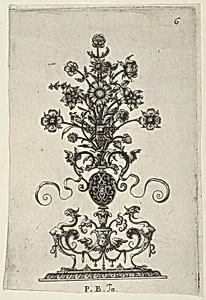
Reverse Copy of Design for a Pendant, from Ars His Myronis Nobilis Effingitus Pagellulis
ca. 1600
Medium
Engraving and blackwork
Dimensions
Sheet: 5 3/16 × 3 3/4 in. (13.1 × 9.5 cm)
Classification
Prints|Ornament & Architecture
Department
Drawings and Prints
Museum
Metropolitan Museum of Art, New York, NY
Credit
Harris Brisbane Dick Fund, 1923
Accession Number
23.88.5
Rights
Public Domain
Tags
Art Historical Context
Step into the intricate world of Renaissance ornamentation with *Reverse Copy of Design for Pendant*, an engraving by Paul Birckultz from around 1600. Part of the publication *Ars His Myronis Nobil Effingitus Pagell*—likely a showcase of noble, effigied designs—this petite print (just 5 3/16 × 3 3/4 inches) served as a blueprint for jewelers crafting elegant pendants. Its "reverse copy" nature hints at the era's collaborative print culture, where designs were and adapted for practical use in workshops across Europe. Birckenhultz masterfully combines engraving—precise lines incised into a metal plate for reproduction—with blackwork, a technique using dense ink washes or cross-hatching to create rich shadows and depth. The composition bursts with motifs of birds, faces, and flowers, weaving natural grace with human portraiture in a harmonious, symmetrical pattern. These elements reflect the Northern Renaissance fascination with classical antiquity and nature, drawing from ancient sculptors like Myron (evoked in the title) to inspire contemporary crafts. Housed in the Metropolitan Museum of Art's Drawings and Prints department, this work exemplifies how affordable prints democratized high design, empowering artisans from goldsmiths to embroiderers. A tiny treasure that once guided hands in creating wearable art, it reminds us of the enduring allure of pattern books in shaping Renaissance luxury.