
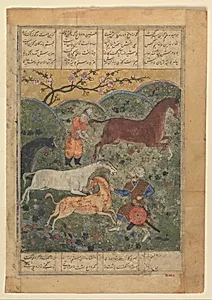
"Rustam Captures the Horse Rakhsh", Folio from a Shahnama (Book of Kings) of Firdausi
late 15th century
Medium
Ink, opaque watercolor, and gold on paper
Dimensions
Page: H. 12 3/8 in. (31.4 cm) W. 8 3/8 in. (21.3 cm) Image: H. 11 5/16 in. (28.7 cm) W. 7 in. (17.8 cm) Mat: H. 19 1/4 in. (48.9 cm) W. 14 1/4 in. (36.2 cm)
Classification
Codices
Department
Islamic Art
Museum
Metropolitan Museum of Art, New York, NY
Credit
Rogers Fund, 1913
Accession Number
13.160.5
Rights
Public Domain
Tags
Art Historical Context
This vibrant folio from a late 15th-centuryShahnama* (Book of Kings) by the poet Abu'l Qasim Firdausi captures heroic moment when the legendary warrior Rustam lassoes and tames the wild horse Rakhsh, his faithful companion in countless epic battles. The *Shahnama*, completed around 1010 CE, is Iran's national epic, blending myth, history, and moral tales of pre-Islamic kings and heroes. Produced in a Persian workshop during the turbulent Timurid or Turkmen era, such illuminated manuscripts were prized treasures for royal courts, celebrating cultural identity amid political upheaval. Rendered in ink outlines, opaque watercolors, and shimmering gold on paper, the artwork exemplifies Persian miniature painting's mastery. Fine brushwork animates the muscular horse and determined Rustam against a patterned landscape, with gold accents heightening drama and divine favor. Measuring about 12 x 8 inches, this page from the Metropolitan Museum of Art's Islamic Art collection highlights the codex tradition—hand-copied and illustrated volumes that preserved oral epics for generations, blending storytelling with exquisite artistry. Fun fact: Rakhsh isn't just any steed; he's a symbol of loyalty, often outsmarting foes alongside Rustam, making this capture a pivotal origin story in Persian lore.
About the Artist
Abu'l Qasim Firdausi · 935–1020
Abu'l Qasim Firdausi, born around 940 in the village of Paj near Tus in Khorasan (modern-day Iran), emerged from a family of landed gentry known as dehqans, who preserved ancient Iranian oral traditions amid the cultural renaissance of the Samanid Empire. Little is documented about his early life or formal training, though he likely received a basic education including Arabic literacy, immersing h...