
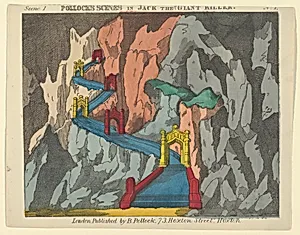
Scene 1, from Jack and the Giant Killer, Scenes for a Toy Theater
1870–90
Medium
Lithograph
Dimensions
Sheet: 6 11/16 × 8 7/16 in. (17 × 21.4 cm)
Classification
Prints
Department
Drawings and Prints
Museum
Metropolitan Museum of Art, New York, NY
Credit
The Elisha Whittelsey Collection, The Elisha Whittelsey Fund, 1952
Accession Number
52.541.1(9)
Rights
Public Domain
Tags
Art Historical Context
This vibrant lithograph by Benjamin Pollock captures Scene 1 from the beloved tale of Jack and the Giant Killer, designed as part of a 19th-century toy theater. Created between 1870 and 1890, the print was intended for children and families to cut out, assemble, and stage their own miniature performances at home. Measuring just over 6 by 8 inches, it depicts a lively street scene featuring gates and architectural details that would have served as the dramatic backdrop for Jack’s heroic adventures. Toy theaters enjoyed immense popularity during the Victorian era, offering an affordable form of entertainment and imaginative play long before cinema or television. Pollock, a prominent London publisher, specialized in these colorful paper sets, which brought classic stories like Jack and the Giant Killer to life through intricate, hand-colored designs. The lithograph technique allowed for affordable mass production while preserving the lively details that made each scene visually engaging. Today, this work in the Metropolitan Museum’s collection highlights how printmaking bridged art, storytelling, and childhood wonder. Its modest scale and theatrical purpose remind us of the creative ways people once experienced narrative and spectacle in their own homes.