
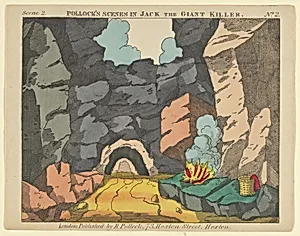
Scene 2, from Jack and the Giant Killer, Scenes for a Toy Theater
1870–90
Medium
Lithograph
Dimensions
Sheet: 6 11/16 × 8 7/16 in. (17 × 21.4 cm)
Classification
Prints
Department
Drawings and Prints
Museum
Metropolitan Museum of Art, New York, NY
Credit
The Elisha Whittelsey Collection, The Elisha Whittelsey Fund, 1952
Accession Number
52.541.1(10)
Rights
Public Domain
Tags
Art Historical Context
Step into the whimsical world of Victorian toy theaters with *Scene 2, from and the Giant Killer, for a Toy Theater* Benjamin Pollock, created between 1870 and 1890. This vibrant lithograph, measuring just 6 11/16 × 8 7/16 inches, captures a dramatic moment—likely involving shadowy tunnels—from the beloved English folktale. Printed in Pollock's London workshop, it was designed as a stage backdrop for miniature home performances, where children could act out heroic adventures with paper characters and props. Pollock, a master printer continuing a family legacy from his uncle John Redington, popularized "penny plain, twopence coloured" toy theater sheets. These affordable lithographs brought theater to middle-class parlors during the late 19th century, fostering imagination amid the era's growing interest in fairy tales and pantomime. Lithography's precision allowed bold colors and intricate details, making scenes like this tunnel-filled escapade pop under candlelight. Housed in the Metropolitan Museum of Art's Drawings and Prints department, this piece from The Elisha Whittelsey Collection highlights toy theaters' cultural role in democratizing entertainment. It reminds us how simple prints sparked creativity, turning ordinary kids into directors of epic tales.