
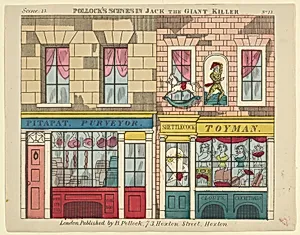
Scene 12, from Jack and the Giant Killer, Scenes for a Toy Theater
1870–90
Medium
Lithograph
Dimensions
Sheet: 6 11/16 × 8 7/16 in. (17 × 21.4 cm)
Classification
Prints
Department
Drawings and Prints
Museum
Metropolitan Museum of Art, New York, NY
Credit
The Elisha Whittelsey Collection, The Elisha Whittelsey Fund, 1952
Accession Number
52.541.1(20)
Rights
Public Domain
Tags
Art Historical Context
This lithograph, created by Benjamin Pollock between 1870 and 1890, forms part of a series titled *Scenes for a Toy Theater* based on classic tale *Jack and Giant Killer*. Measuring just over6 by 8 inches the print was designed for cutting out and assembling into a miniature, reflecting the Victorian era’s fascination with affordable home entertainment. Pollock, a prominent London publisher of such sheets, used lithography to produce vibrant, detailed scenes that brought popular stories to life for children and families. Toy theaters enjoyed widespread popularity in 19th-century Britain as a creative pastime that combined storytelling, craftsmanship, and performance. These paper stages allowed young audiences to reenact fairy tales and melodramas, fostering imagination while mirroring the grandeur of professional productions. The medium of lithography was ideal for this purpose, enabling the mass production of colorful, affordable prints that captured dramatic moments like the confrontation between Jack and the giant. Today, this work offers a charming glimpse into Victorian leisure culture and the enduring appeal of illustrated narratives. Housed in the Metropolitan Museum of Art’s collection of prints, it highlights how art once served not only as decoration but as an interactive gateway to literature and theater.