
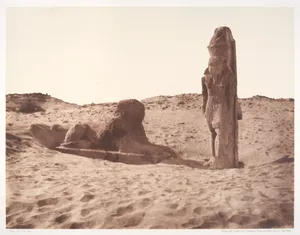
Séboûah, Temple, Colosse et Sphinx de la Partie Gauche de l'Avenue
1851–52
Medium
Salted paper print from paper negative
Dimensions
Image: 24 × 31.1 cm (9 7/16 × 12 1/4 in.) Mount: 37.9 × 50.2 cm (14 15/16 × 19 3/4 in.)
Classification
Photographs
Department
Photographs
Museum
Metropolitan Museum of Art, New York, NY
Credit
Gilman Collection, Purchase, Ann Tenenbaum and Thomas H. Lee Gift, 2005
Accession Number
2005.100.62
Rights
Public Domain
Tags
Art Historical Context
In 1851–52, French photographer Félix Teynard ventured along the Nile as part of an ambitious expedition to document Egypt's ancient wonders, producing of the earliest comprehensive photographic surveys of the region. His salted paper print, *Séboûah,, Colosse et Sphinx la Partie Gauche l'Avenue*, captures the majestic left side of the temple avenue at the remote Temple of Sebua in Nubia. Towering sphinxes, a massive colossus, and ornate temple facade emerge from the sun-baked desert, their weathered forms testifying to pharaonic grandeur amid vast sands. This image exemplifies the calotype process—Teynard's paper negatives yielding richly toned salted paper prints with subtle gradations ideal for expansive landscapes and intricate sculptures. Unlike earlier drawings, photography offered unprecedented accuracy, fueling 19th-century Egyptomania in Europe and preserving sites threatened by time and tourism. Teynard's precise compositions rivaled paintings, blending scientific documentation with artistic vision. Today, housed in The Metropolitan Museum of Art's Gilman Collection, this print invites visitors to trace the footsteps of explorers, revealing how early photography bridged ancient history and modern curiosity. (198 words)
About the Artist
Félix Teynard · 1817–1892
**Félix Teynard (1817–1892)** was a pioneering French photographer whose work captured the ancient wonders of Egypt and Nubia with unprecedented precision and artistry. Born on January 14, 1817, in Saint-Flour, he trained as a civil engineer in Grenoble, a hub of Egyptology that likely sparked his fascination with ancient architecture. Little is documented about his early life or formal photograph...