
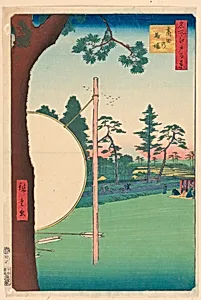
Takata Riding Grounds (Takata-no-baba) From the Series One Hundred Famous views of Edo
Classification
landscapes
Department
Smithsonian Collection
Museum
Smithsonian American Art Museum
Credit
Gift of the Estate of Mrs. Robert H. Patterson
Accession Number
1941-31-268
Rights
Public Domain
About this artwork
Research in Progress
Art Historical Context
Ando Hiroshige, one of Japan’s most celebrated ukiyo-e masters, created “Takata Riding Grounds (Takata-no-baba)” in 1857 as part of his landmark series “One Hundred Views of Edo.” This captures a well-known in the bustling capital, called Edo and now, where riding grounds served military training and public. Hiroshige’s, produced near the end of his life offered viewers a panoramic tour the city’s seasonal and everyday scenes. Class simply as a landscape, the print reflects the broader cultural importance of ukiyo in documenting Japan’s rapidly changing urban environment during the late Edo period. Hiroshige’s compositions often balanced precise topographical detail with atmospheric effects, inviting viewers to feel the passage of time and weather across familiar places. The work’s presence in the Smithsonian American Art Museum, a gift from the Estate of Mrs. Robert H. Patterson, underscores its enduring appeal to international audiences. Today the piece continues to introduce museum visitors to the quiet poetry of nineteenth-century Japanese city views and Hiroshige’s lasting influence on how landscapes can convey both place and feeling.