
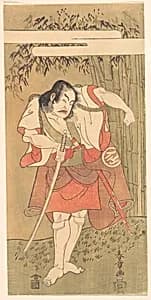
The Actor Nakamura Sukegoro I with His Sword Drawn in a Defiant Attitude
1726–1792
Medium
Woodblock print (nishiki-e); ink and color on paper
Dimensions
11 7/8 x 5 3/4 in. (30.2 x 14.6 cm)
Classification
Prints
Culture & Period
Japan · Edo period (1615–1868)
Department
Asian Art
Museum
Metropolitan Museum of Art, New York, NY
Credit
Henry L. Phillips Collection, Bequest of Henry L. Phillips, 1939
Accession Number
JP2891
Rights
Public Domain
Tags
Art Historical Context
Step into the vibrant world of Edo-period Japan with Katsukawa Shunshō'sThe Actor Nakamura Sukegoro I with His Sword Drawn a Defiant Attitude* (c. late 18th century). This striking woodblock print captures the kabuki star Nakamura Sukegoro I in a bold, theatrical pose, sword poised in defiance. Shunshō (1726–1792), a leading figure in the ukiyo-e tradition—"pictures of the floating world"—specialized in yakusha-e, intimate portraits of actors that brought the drama of kabuki theater to everyday viewers. Printed as a nishiki-e, or "brocade picture," using intricate woodblock techniques with ink and vibrant colors on paper, this small-format work (about 12 x 6 inches) exemplifies the artistry of multi-block printing. Layers of color were meticulously aligned to create lifelike expressions and dynamic movement, making high art accessible to the masses during Japan's Edo period (1615–1868). Kabuki, with its exaggerated gestures and all-male casts, was a cultural phenomenon, and prints like this immortalized performers as celebrities. From the Metropolitan Museum of Art's Henry L. Phillips Collection, this piece highlights Shunshō's influence in founding the Katsukawa school, shaping generations of printmakers. It invites us to feel the tension of the stage—sword gleaming, actor unyielding—in a frozen moment of Edo bravado.
About the Artist
Katsukawa Shunshō 勝川春章 (Japanese) · 1726 –1792
Japanese, 1726–1792