
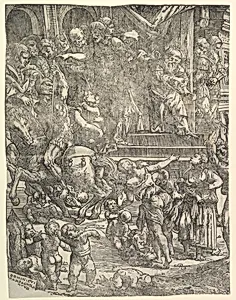
The Massacre of the Innocents (Left side), with man on horseback at center left, women and children below, group of figures standing on steps above, Herod seated on throne at upper right
Medium
Woodcut
Dimensions
Sheet (Trimmed): 20 11/16 × 15 13/16 in. (52.5 × 40.2 cm)
Classification
Prints
Department
Drawings and Prints
Museum
Metropolitan Museum of Art, New York, NY
Credit
Gift of Rijksmuseum, 1960
Accession Number
60.523
Rights
Public Domain
Tags
Art Historical Context
Domenico Campagnola’s 1517 woodcut *The Massacre of the Innocents* captures the biblical tale of King Herod’s brutal order to slaughter Bethlehem’s male infants. The left half of this large print shows a mounted soldier charging through a crowd of terrified mothers and children, while figures on steps above witness the chaos and Herod sits enthroned at upper right. The dramatic composition draws viewers into the center of the violence, emphasizing both human suffering and royal authority. Created during the High Renaissance, the woodcut reflects the period’s growing interest in dynamic storytelling and classical themes. As a print medium, woodcuts allowed artists like Campagnola to reach wide audiences beyond elite collectors; the bold lines and clear contrasts were well suited to the narrative intensity of this scene. Measuring roughly 21 by 16 inches, the sheet was trimmed from a larger block, suggesting it may have formed part of a two-part composition. Today in the Metropolitan Museum’s collection, the work offers a vivid window into sixteenth-century printmaking and the enduring power of biblical stories to address themes of power, innocence, and loss.
About the Artist
Domenico Campagnola · 1500–1564
Domenico Campagnola (c. 1500–1564), a Venetian Renaissance painter, engraver, and pioneering draftsman, was born around 1500, likely in Venice to German parents, and became a child prodigy under the tutelage of his adoptive father, Giulio Campagnola. Apprenticed to Giulio around 1507 in Venice, he mastered painting, drawing, engraving, and woodcutting from the esteemed Paduan engraver, whose stipp...