
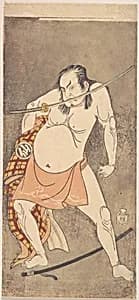
The Second Nakamura Sukegoro as a Man Entirely Nude Save for Loin Cloth
1768 or 1769
Medium
Woodblock print (nishiki-e); ink and color on paper
Dimensions
12 x 5 1/2 in. (30.5 x 14.0 cm)
Classification
Prints
Culture & Period
Japan · Edo period (1615–1868)
Department
Asian Art
Museum
Metropolitan Museum of Art, New York, NY
Credit
Purchase, Joseph Pulitzer Bequest, 1918
Accession Number
JP454
Rights
Public Domain
Tags
Art Historical Context
In the vibrant world of Edo-period Japan (1615–1868), Katsukawa Shunshō (6–1792), a leading ukiyo-e master the Katsukawa school, the allure of kabuki theater in this striking woodblock print from 1768 or 1769. Titled *The Second Nakamura Sukeg as a Man Entirelyude Save for Loin*, it portrays the famed actor Nakamura Sukegoro II—known for his skill in both male and female roles—in a powerful, near-nude pose clad only in a traditional fundoshi loincloth, likely evoking a fierce warrior with swords at hand. Shunshō's yakusha-e (actor prints) brought kabuki stars to life for everyday admirers, turning theater icons into affordable, colorful souvenirs. This nishiki-e, or "brocade picture," exemplifies the revolutionary full-color woodblock printing technique that emerged in the 1760s, layering vibrant inks on paper for rich, lifelike effects. Measuring just 12 x 5½ inches, its intimate scale suited personal collections, while Shunshō's dynamic composition highlights the actor's muscular form and dramatic intensity—a nod to kabuki's bold mie poses. Acquired by the Metropolitan Museum of Art in 1918, this print reflects ukiyo-e's cultural role in democratizing art, celebrating the era's obsession with beauty, performance, and transient pleasures.
About the Artist
Katsukawa Shunshō 勝川春章 (Japanese) · 1726 –1792
Japanese, 1726–1792