
Tobacco Pouch and Pipe
1813
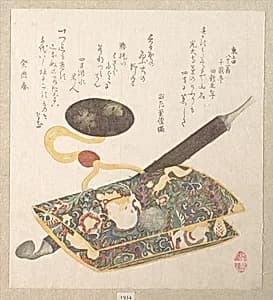
Medium
Woodblock print (surimono); ink and color on paper
Dimensions
7 7/8 x 7 1/8 in. (20 x 18.1 cm)
Classification
Prints
Culture & Period
Japan · Edo period (1615–1868)
Department
Asian Art
Museum
Metropolitan Museum of Art, New York, NY
Credit
H. O. Havemeyer Collection, Bequest of Mrs. H. O. Havemeyer, 1929
Accession Number
JP1954
Rights
Public Domain
Tags
Art Historical Context
Kubo Shunman’s “Tobacco Pouch and Pipe,” created in1813 during Japan’s Edo period, is a refined example of surimono—a privately commissioned woodblock print intended for poetry circles and special occasions. Unlike commercial ukiyo-e prints, surimono were produced in limited numbers with exceptional care, often incorporating delicate color gradations, embossing, and metallic pigments on luxurious paper. This intimate still life captures the quiet elegance of everyday objects, reflecting the period’s appreciation for refined simplicity and the rituals of daily life. Tobacco had become a popular pastime among townspeople and samurai alike by the early nineteenth century, and the pouch and pipe shown here would have been familiar accessories. Shunman’s sensitive rendering highlights the textures of woven fabric, lacquered pipe, and soft folds of cloth, inviting viewers to pause and savor small moments of beauty. The print’s modest size—roughly eight by seven inches—further emphasizes its personal, contemplative character. Housed today in the Metropolitan Museum of Art as part of the H. O. Havemeyer bequest, the work exemplifies how surimono bridged art and poetry, transforming ordinary subjects into elegant visual statements that continue to charm museum visitors.
About the Artist
Kubo Shunman · 1757–1820
Japanese, 1757–1820