
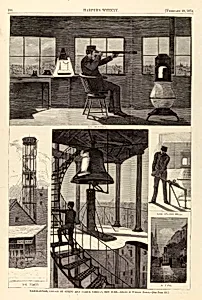
Watch-Tower, Corner of Spring and Varick Streets, New York, from Harper's Weekly, February 28, 1874
1874
Medium
Graphic Arts-Print
Classification
Graphic Arts-Print
Department
Smithsonian Collection
Museum
Smithsonian American Art Museum
Credit
Smithsonian American Art Museum, The Ray Austrian Collection, gift of Beatrice L. Austrian, Caryl A. Austrian and James A. Austrian
Accession Number
1996.63.93
Rights
Public Domain
Tags
Art Historical Context
Step into 1874 New York City with Winslow Homer's striking illustration, *Watch-Tower, Corner of Spring and Var Streets, New York*, published in *Harper's Weekly* on February 28. Homer, a master of American Realism renowned for his vivid depictions of everyday life—from Civil War battlefields to rural scenes—captured this urban sentinel in intricate wood engraving. As a leading contributor to the era's premier illustrated newspaper, Homer brought the pulse of the Gilded Age metropolis to readers nationwide. The print showcases a sturdy watch-tower perched at the bustling intersection of Spring and Varick Streets in lower Manhattan. Featuring a prominent bell, winding stairs, and a vigilant watchman, it evokes the city's vigilant fire-watch system, where lookouts scanned for blazes amid wooden tenements and rapid growth. These towers were lifelines in a pre-telephone era, signaling alarms that rallied volunteer firefighters. Homer's precise lines and dramatic contrasts highlight the tower's architectural grit, blending functionality with quiet heroism. Preserved in the Smithsonian American Art Museum's Ray Austrian Collection, this graphic art gem offers a window into New York's transformation, reminding us how artists like Homer chronicled the American city's spirited evolution.
About the Artist
Winslow Homer · 1836–1910
Winslow Homer (1836-1910) was one of America's greatest painters and a preeminent figure in 19th-century American art. Largely self-taught, Homer began his career as a commercial illustrator and Civil War correspondent for Harper's Weekly before becoming renowned for his powerful marine subjects and landscape paintings. His mastery of both oil and watercolor, combined with his uncompromising reali...