
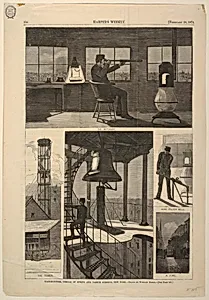
Watch-tower, Corner of Spring and Varick Streets, New York
February 28, 1874
Medium
graphic design
Classification
graphic design
Department
Smithsonian Collection
Museum
Smithsonian American Art Museum
Credit
Gift of Cora Wilson
Accession Number
1939-70-9
Rights
Public Domain
About this artwork
Research in Progress
Art Historical Context
Winslow Homer, one of America's foremost realist artists (1836–1910), captured the gritty pulse of New York City in his 1874 graphic design *Watch-tower, Corner Spring and Varick Streets New York*. Created on February 28, work depicts a fire watchtower at a bustling SoHo intersection, a vital urban landmark in an era when wooden high-rises and rapid growth heightened fire risks. Before modern fire departments, these towers allowed watchmen to spot blazes from afar, symbolizing the precarious balance of progress and peril in Gilded Age Manhattan. Homer, transitioning from Civil War illustrations for *Harper's Weekly* to mature paintings of American life, excelled in graphic media like wood engravings and lithographs. His precise lines and dramatic compositions brought everyday scenes to vivid life, blending journalistic detail with artistic insight. This piece reflects his early mastery of urban realism, offering a window into 1870s New York—immigrant neighborhoods, industrial clamor, and resilient city dwellers. Housed in the Smithsonian American Art Museum as a gift from Cora Wilson, *Watch-tower* highlights Homer's versatility beyond canvas. Though research continues, it stands as a testament to his eye for the ordinary made extraordinary, inviting visitors to ponder the watchful guardians of a growing metropolis.