
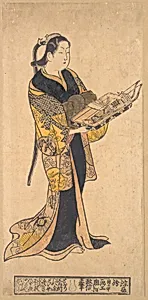
Woman with Toys for the Boys' Festival
ca. 1730
Medium
Woodblock print (hand colored); ink and color on paper
Dimensions
12 3/4 x 6 1/4 in. (32.4 x 15.9 cm)
Classification
Prints
Culture & Period
Japan · Edo period (1615–1868)
Department
Asian Art
Museum
Metropolitan Museum of Art, New York, NY
Credit
Harris Brisbane Dick Fund and Rogers Fund, 1949
Accession Number
JP3077
Rights
Public Domain
Tags
Art Historical Context
In the vibrant world of Edo-period Japan (1615–1868), Okumura Masanobu's *Woman with Toys for the Boys Festival* (ca. 1730) captures a of everyday festivity through the ukiyo-e tradition—"pictures of the floating world Masanobu, a pioneeringmaker, excelled in colorful woodblock prints that brought urban life to the masses. This hand-colored ink and color on paper measures a compact 12 3/4 x 6 1/4 inches, ideal for home display or albums. The image depicts a graceful woman carrying an array of toys destined for the Boys' Festival (Tango no Sekku), celebrated on the fifth day of the fifth month with displays of dolls, helmets, and figures symbolizing strength and valor for young boys. These toys, often inspired by samurai warriors and mythical heroes, underscored cultural values of masculinity and protection amid family rituals marked by carp streamers and iris baths for health. Masanobu's technique shines in the precise woodblock carving and delicate hand-coloring, which added vivid pinks, greens, and golds to evoke seasonal joy. As an early innovator in multi-color printing precursors, his work democratized art, reflecting Japan's booming print culture and offering visitors a window into 18th-century domestic life and gender roles.
About the Artist
Okumura Masanobu · 1686–1764
Japanese, 1686–1764