
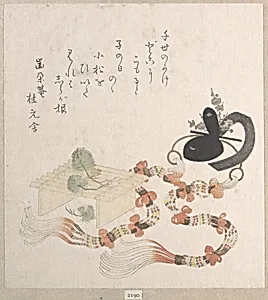
Young Pine Trees on a Stand and a Ceremonial Crown with Long Hangings
18th–19th century
Medium
Woodblock print (surimono); ink and color on paper
Dimensions
7 7/8 x 7 3/16 in. (20 x 18.3 cm)
Classification
Prints
Culture & Period
Japan · Edo period (1615–1868)
Department
Asian Art
Museum
Metropolitan Museum of Art, New York, NY
Credit
H. O. Havemeyer Collection, Bequest of Mrs. H. O. Havemeyer, 1929
Accession Number
JP2190
Rights
Public Domain
Tags
Art Historical Context
This exquisite woodblock print, titled *Young Pine Trees on a Stand and a Ceremonial with Long Hangings*,ails from Japan's Edo period (16151868), a time of cultural flourishing under the Tokugawa shogunate. Created by an unidentified artist in the 18–19th century, exemplifies *surimono*—privately commissioned prints often produced for New Year's greetings or poetry circles. Measuring just 7⅞ × 7³⁄₁₆ inches, its intimate scale invited close appreciation, blending nature and ritual in vibrant ink and color on paper. Central to the composition are young pine trees on a stand, evoking *kadomatsu* decorations symbolizing longevity, prosperity, and renewal—auspicious motifs for welcoming the new year. Paired with them is a ceremonial crown adorned with long hangings, likely referencing Noh theater headpieces or imperial regalia, which signified elegance and spiritual authority in Japanese courtly life. Woodblock printing techniques, involving meticulously carved blocks for layered colors and subtle gradients, highlight the medium's precision and artistry, making surimono prized collector's items. Now part of the Metropolitan Museum of Art's H. O. Havemeyer Collection, this print offers a window into Edo Japan's refined aesthetic sensibilities, where everyday rituals intertwined with profound symbolism. Visitors, pause to admire how such small works captured the era's poetic harmony.