
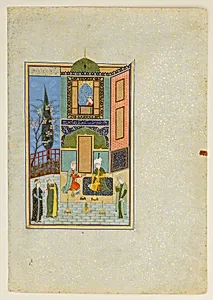
"Bahram Gur in the Green Palace on Monday", Folio 224 from a Khamsa (Quintet) of Nizami of Ganja
A.H. 931/1524–25 CE
Medium
Ink, opaque watercolor, silver, and gold on paper
Dimensions
Painting: H. 7 1/4 in. (18.4 cm) W. 5 in. (12.7 cm) Page: H. 12 3/4 in. (32.4 cm) W. 8 5/8 in. (21.9 cm) Mat: H. 19 1/4 in. (48.9 cm) W. 14 1/4 in. (36.2 cm)
Classification
Codices
Department
Islamic Art
Museum
Metropolitan Museum of Art, New York, NY
Credit
Gift of Alexander Smith Cochran, 1913
Accession Number
13.228.7.12
Rights
Public Domain
Tags
Art Historical Context
This exquisite folio, dated 1524–25, comes from a lavishly illustrated manuscript of Nizami of Ganja’s Khamsa, one of the most celebrated poetic works in Persian literature. The scene depicts the Sasanian king Bahram Gur visiting the green palace on Monday, where he encounters one of the seven princesses in the romantic epic Haft Paykar (Seven Beauties). Each palace, painted a different color, represents a day of the week and a stage in the hero’s journey toward wisdom and love. Created during the early Safavid period, the painting exemplifies the refined art of Persian miniature illumination. Artists employed delicate ink outlines, vibrant opaque watercolors, and shimmering gold and silver to bring the poetic narrative to life on the page. Such manuscripts were treasured at royal courts, where the interplay of text and image served both to entertain and to convey moral and philosophical ideals. Measuring just over seven inches high, the intimate scale invites close viewing, revealing intricate details of costume, architecture, and symbolic color that enrich Nizami’s timeless story for today’s museum visitors.