
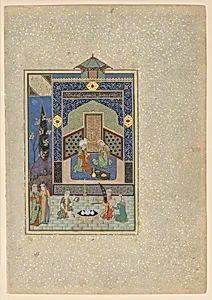
"Bahram Gur in the Turquoise Palace on Wednesday", Folio 216 from a Khamsa (Quintet) of Nizami of Ganja
dated A.H. 931/1524–25 CE
Medium
Ink, opaque watercolor, silver, and gold on paper
Dimensions
Painting: H. 7 7/8 in. (20 cm) W.4 7/8 in. (12.4 cm) Page: H. 12 11/16 in. (32.2 cm) W. 8 3/4 in. (22.2 cm) Mat: H. 19 1/4 in. (48.9 cm) W. 14 1/4 in. (36.2 cm)
Classification
Codices
Department
Islamic Art
Museum
Metropolitan Museum of Art, New York, NY
Credit
Gift of Alexander Smith Cochran, 1913
Accession Number
13.228.7.10
Rights
Public Domain
Tags
Art Historical Context
This exquisite folio, titled "Bahram Gur in the Turquoise Palace on Wednesday," comes from a lavishly illustrated 1524–25 manuscript of Nizami’s Khamsa, one of the most celebrated poetic works in Persian literature. The scene captures the Sasanian king Bahram Gur during his visit to a turquoise-colored palace associated with the planet Mercury, where music, poetry, and courtly splendor unfold. Created in the early Safavid period, the page reflects the refined court culture of 16th-century Iran, where literature and visual storytelling were deeply intertwined. The illumination is the collaborative work of several master artists, including Sultan Muhammad Nur, Mahmud Muzahib, and Shaikh Zada. Their combined efforts showcase the delicate precision of Persian miniature painting, using fine lines of ink, vibrant opaque watercolors, and luminous touches of gold and silver to evoke the opulence of the palace interior. Musical instruments and elegantly posed figures emphasize the Wednesday theme of harmony and delight. As part of a codex rather than a standalone image, this folio was designed to be viewed in sequence with the surrounding text. Its presence in the Metropolitan Museum’s Islamic Art collection highlights the enduring cultural importance of the Khamsa as both a literary and artistic treasure across centuries.