
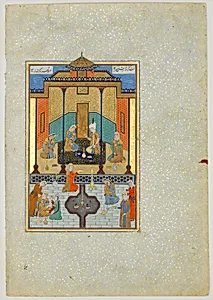
"Bahram Gur in the Sandal Palace on Thursday", Folio 230 from a Khamsa (Quintet) of Nizami of Ganja
A.H. 931/1524–25 CE
Medium
Ink, opaque watercolor, silver, and gold on paper
Dimensions
Painting: H. 7 13/16 in. (19.8 cm) W. 4 5/8 in. (11.7 cm) Page: H. 12 5/8 in. (32.1 cm) W. 8 3/4 in. (22.2 cm) Mat: H. 19 1/4 in. (48.9 cm) W. 14 1/4 in. (36.2 cm)
Classification
Codices
Department
Islamic Art
Museum
Metropolitan Museum of Art, New York, NY
Credit
Gift of Alexander Smith Cochran, 1913
Accession Number
13.228.7.13
Rights
Public Domain
Tags
Art Historical Context
Behold *Bahram Gur in the Sand Palace on Thursday*, Folio230 from a lavish *Khamsa* (Quintet) of the 12th-century Persian poetizami of Ganja. Created in 1524–25 CE during the Safavid in Persia, this exquisite page captures a romantic episode from *Haft Peykar* (Seven Beauties), where legendary Sasanian king Bahram Gur one of his seven princesses, each housed in a domed pavilion representing a day of the week. Attributed to master artists Sultan Muhammad Nur and Shaikh Zada, it exemplifies the Tabriz school’s pinnacle of manuscript illumination. Rendered in ink, opaque watercolor, silver, and gold on paper, the miniature (measuring just 7 13/16 x 4 5/8 inches) bursts with vibrant jewel tones and intricate details—flowing robes, architectural splendor, and tender interactions between men and women. Gold and silver heighten its opulence, reflecting the patronage of Shah Tahmasp, whose court workshops produced some of Islam’s most treasured codices. This codex page, now in the Metropolitan Museum of Art’s Islamic Art Department (gift of Alexander Smith Cochran, 1913), showcases Persian miniature painting’s narrative power and technical virtuosity. A window into 16th-century courtly ideals of love, kingship, and beauty, it invites us to ponder timeless tales amid shimmering artistry.