
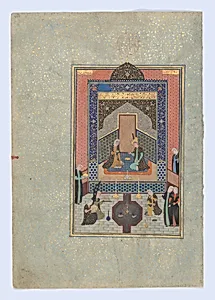
"Bahram Gur in the Dark Palace on Saturday", Folio 207 from a Khamsa (Quintet) of Nizami of Ganja
A.H. 931/1524–25 CE
Medium
Ink, opaque watercolor, silver, and gold on paper
Dimensions
Painting: H. 8 in. (20.3 cm) W. 4 1/2 (11.4 cm) Page: H. 12 1/2 in. (31.9 cm) W. 8 3/4 in. (22.2 cm) Mat: H. 19 1/4 in. (48.9 cm) W. 14 1/4 in. (36.2 cm)
Classification
Codices
Department
Islamic Art
Museum
Metropolitan Museum of Art, New York, NY
Credit
Gift of Alexander Smith Cochran, 1913
Accession Number
13.228.7.8
Rights
Public Domain
Tags
Art Historical Context
This exquisite folio, titled *"Bahram Gur in the Palace on Saturday"* (Folio 207), comes from a lavishly illustrated *Khamsa* (Quintet)—a collection of five epic poems by 12th-century Persian poet Nami of Ganja. in 1524–25 CE during the Safavid dynasty in Persia, it depicts a legendary scene from the tale of Bahram Gur, Sasanian king famed for his adventures with seven princesses. Here, in the pitch-black Saturday palace ruled by the ebony-skinned princess, Bahram listens to haunting music, surrounded by women and instruments—a clever narrative device symbolizing sensory perception and royal prowess. Rendered in ink, opaque watercolor, silver, and gold on paper by master artists including Sultan Muhammad, Mahmud Muzahhib, and Shaikh Zada, the miniature exemplifies the pinnacle of Safavid illumination. Fine ink outlines define elegant figures and intricate architectural details, while vibrant colors and shimmering metals create a jewel-like glow on the compact 8 x 4½-inch painting. This codex style reflects the era's patronage of courtly manuscripts, blending poetry, storytelling, and artistry to educate and delight elites. Housed in the Metropolitan Museum of Art's Islamic Art Department (gift of Alexander Smith Cochran, 1913), this folio highlights Persianate culture's fusion of literature and visual splendor, where music, kingship, and feminine allure evoke timeless themes of love and illusion. A true gem of 16th-century book arts!