
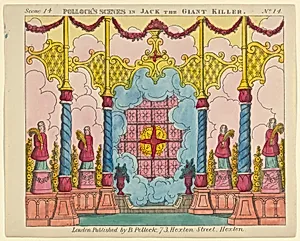
Scene 14, from Jack and the Giant Killer, Scenes for a Toy Theater
1870–90
Medium
Lithograph
Dimensions
Sheet: 6 11/16 × 8 7/16 in. (17 × 21.4 cm)
Classification
Prints
Department
Drawings and Prints
Museum
Metropolitan Museum of Art, New York, NY
Credit
The Elisha Whittelsey Collection, The Elisha Whittelsey Fund, 1952
Accession Number
52.541.1(22)
Rights
Public Domain
Tags
About this artwork
This colorful lithograph represents a scene from the popular fairy tale 'Jack and the Giant Killer,' published by Benjamin Pollock for Victorian toy theaters between 1870 and 1890. Toy theaters—known during the period as 'juvenile drama'—constituted a significant form of children's entertainment in nineteenth-century Britain, allowing families to stage miniature theatrical productions at home. Benjamin Pollock (1857–1937) became the most famous purveyor of these theatrical sheets, operating from...
Art Historical Context
Step into the whimsical world of Victorian toy theaters *Scene 14* from Benjamin Pollock's *Jack and the Giant* series, a vibrant lithograph created between 1870 and1890. This colorful print captures a dramatic moment from the beloved English fairy, designed as part of "juvenile drama" sheets brought miniature theater to British homes. Pollock (1857–1937), the era's most renowned publisher of these delights from his Hoxton Street shop, produced scenery drops and character cutouts that children eagerly assembled. Toy theaters were a cherished form of 19th-century family entertainment, blending printmaking with performance. Kids cut out figures, mounted them on card, and animated them with wires on homemade stages—sparking creativity and introducing dramatic tales like Jack's heroic battles. Pollock's catchy slogan, "a penny plain, twopence coloured," let families choose plain sheets for DIY coloring or ready-to-play vibrancy, making theater accessible to all. This lithograph, now in the Metropolitan Museum of Art's Elisha Whittelsey Collection (acquired 1952), preserves a slice of popular culture. Featured in the 2016 exhibition *The Power of Prints*, it highlights how such prints bridged art, education, and play, enchanting generations with fairy-tale magic.