
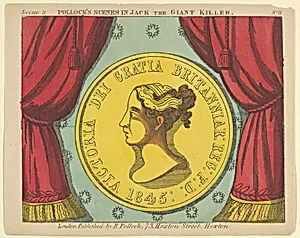
Scene 11, from Jack and the Giant Killer, Scenes for a Toy Theater
1870–90
Medium
Lithograph
Dimensions
Sheet: 6 11/16 × 8 7/16 in. (17 × 21.4 cm)
Classification
Prints
Department
Drawings and Prints
Museum
Metropolitan Museum of Art, New York, NY
Credit
The Elisha Whittelsey Collection, The Elisha Whittelsey Fund, 1952
Accession Number
52.541.1(19)
Rights
Public Domain
Tags
Art Historical Context
This lithograph by Benjamin Pollock, titled *Scene 11, from Jack and the Giant Killer, Scenes for a Toy Theater*, dates to the late nineteenth century, a period when toy theaters flourished as popular home entertainment in Britain. Measuring just 6 11/16 by 8 7/16 inches, the print was designed for assembly and performance by children, reflecting the era’s growing interest in accessible, imaginative play. Pollock, a noted publisher of such theatrical sheets, used lithography to produce affordable, vividly colored scenes that brought fairy tales and adventure stories to life on a miniature stage. The work belongs to the Metropolitan Museum of Art’s collection of prints and drawings, acquired through the Elisha Whittelsey Fund in 1952. As a lithograph, it exemplifies the technique’s role in democratizing art during the Victorian age, allowing intricate designs to be reproduced quickly and inexpensively for widespread use. The sheet’s focus on profiles and figures from the classic tale of *Jack and the Giant Killer* highlights how these prints combined storytelling with hands-on creativity, turning familiar legends into interactive experiences for young audiences.